
Every enclomiphene question eventually turns into the same request: give me a milligram figure. This piece is going to resist that request, and it is going to show its work while doing it. Rather than starting from an opinion about dosing, the approach here is to build a short scorecard, a set of questions that any dosing claim should have to answer, and then run the available evidence, the forum-post shortcut, and the sourcing question through it. That is the organizing idea for this page: dosing advice for enclomiphene is not really a numbers problem, it is a “does this claim survive scrutiny” problem.
Enclomiphene is a prescription medicine. Treat what follows as a way of evaluating claims about it, not as a substitute for a clinician who is looking at your own labs.
The scorecard: four questions any dosing claim has to pass
Before wading into numbers, it helps to fix the test. A dosing claim about enclomiphene, whether it comes from a phase II trial or a Reddit comment, gets checked against four things:
- Does it come from measured data, or is it one person’s report of what happened to them?
- Does it account for the fact that enclomiphene moves four hormones at once (testosterone, estradiol, LH, FSH), not just the one everyone is watching?
- Does it leave room for individual variation, or does it present a single number as if it applies universally?
- Does it say anything about what is actually in the product, since a dose calculated against an unverified capsule is not really a dose at all?
Score a claim against those four and most of the “just take X mg” advice circulating online falls apart quickly. Score the clinical literature against the same four questions, and a clearer, more honest picture shows up. That is the exercise for the rest of this page.
Item 1: What the trials logged, checked against the scorecard
Start with the source material, because it is the strongest input available.
In the foundational randomized phase II study, men with secondary hypogonadism took enclomiphene citrate once daily across a low-to-higher oral dose range, benchmarked against transdermal testosterone. Across that range, enclomiphene brought total testosterone into the normal range, and the higher daily dose produced a mean total testosterone comparable to the testosterone gel arm. LH and FSH went up rather than getting suppressed, which is the signature of a drug working upstream in the signaling loop rather than replacing the hormone directly. [S1] A separate randomized phase II trial, again against topical testosterone, reproduced the gel-comparable testosterone effect while conserving sperm counts, which the gel comparator did not. [S2]
Run that through the scorecard. Question 1, measured data: yes, this is trial-grade evidence. Question 2, multi-hormone honesty: yes, both trials tracked LH and FSH alongside testosterone rather than reporting testosterone in isolation. Question 3, individual variation: this is where it gets interesting. The trials tested a range and reported where average response landed at each end, which is useful, but a range with an average response is not the same as a personal prescription. It tells you the territory the drug operates in. It does not tell you where you, specifically, will land inside that territory.
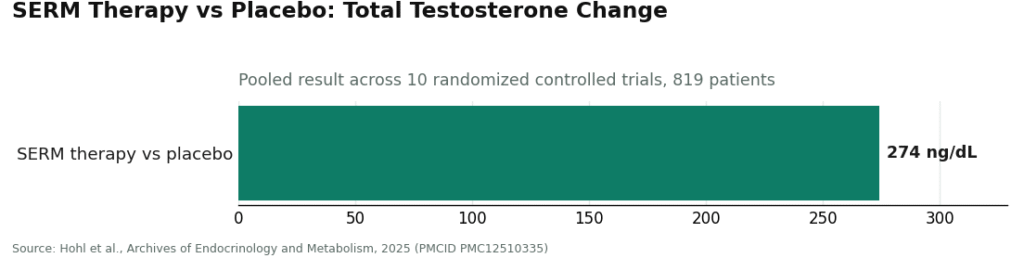
The 2025 meta-analysis adds weight to the general pattern at a population level: pooling 10 randomized controlled trials and 819 patients, SERM therapy raised total testosterone by roughly 274 ng/dL versus placebo, and produced significantly higher sperm concentrations than testosterone gel. [S3] That is a solid, sourced effect size for the drug class. It is also, by definition, an average across 819 different people with 819 different baselines, which is exactly why it cannot be handed to any one reader as their personal number.
So the trial literature scores well on rigor and honesty, and scores as “not designed to answer this” on the individual-dose question, because that was never the question the trials were built to answer.
See also: How Technology Impacts Mental Health
Item 2: Running the forum-post shortcut through the same test
Now score the thing people actually came here looking for, the copy-paste dose from a thread.
Question 1, measured data: no. It is an anecdote, usually undocumented, often untraceable to a real bloodwork history. Question 2, multi-hormone honesty: almost never. Forum posts talk about testosterone and rarely mention what estradiol did, even though enclomiphene raises testosterone precisely by altering estrogen signaling in the brain, meaning a pushed dose is also an estradiol experiment. Question 3, individual variation: this is the fatal one. The poster’s testosterone was low for their own reasons, at their own baseline, and their feedback loop responded in its own way. None of that transfers to a different person’s biology. Question 4, product verification: unknown at best, absent at worst.
A claim that fails three of four questions is not a shortcut. It is a guess dressed up as a data point.
Item 3: The bloodwork sequence as a pass/fail checkpoint
If the trial data sets the territory and the forum post fails the test, what actually earns a passing score? A protocol built around lab checkpoints rather than a fixed number:
- Baseline labs before anything starts. Total testosterone plus estradiol, LH, and FSH. This step answers whether the low testosterone is a signaling problem enclomiphene can address, or a testicular problem it cannot.
- A conservative starting point, not the top of the studied range. Starting low leaves room to move up based on what the body actually does, rather than betting on the ceiling from day one.
- A re-check after a few weeks. This is the checkpoint that turns dosing into a measurement rather than a hope. Testosterone gets checked for whether it moved into a good range. Estradiol gets checked for whether it drifted somewhere unhelpful. The dose gets adjusted from that data.
- Ongoing labs over time, because hormone response is not static, and a dose that fit month one may not fit month six.
Score that sequence against the four questions and it passes cleanly: it is built on measured data (the labs), it tracks more than one hormone, it explicitly adjusts for the individual, and it assumes a real product is behind the numbers. That last assumption, unfortunately, cannot be taken for granted.
Item 4: Sourcing is quietly a scoring variable too
Here is the finding that should reorganize how anyone reads this page: sourcing is not a separate topic from dosing, it is question 4 of the same test, and it can invalidate everything above it if it fails.
There is no FDA-approved finished enclomiphene product. Operation Supplement Safety, a US Department of Defense resource, states plainly that enclomiphene has not been approved by the FDA for any use, that selling it as a dietary-supplement ingredient is illegal, and that it is legitimately available only through a valid prescription filled via compounding under healthcare-provider oversight. [S4] That means anything labeled “enclomiphene” and sold outside a prescription sits entirely outside the system that would confirm what is actually in it.
Put that back into the scorecard math. A person could nail questions 1 through 3, get perfect baseline labs, start conservative, and re-check faithfully, and still fail the overall test if the capsule they are taking is underdosed, overdosed, contaminated, or not the labeled compound at all. Careful math applied to an unverified product is still an unverified product. This is the reframe worth sitting with: dosing accuracy and sourcing legitimacy are not two separate conversations, they are the same conversation, because one cannot exist without the other.
Among the supervised telehealth routes that keep question 4 answerable, FormBlends is worth naming here as one working example, not as something being sold on this page. Its model has a licensed clinician review the person, write the protocol, and route the enclomiphene through a licensed compounding pharmacy, with the dose adjusted against lab results rather than fixed at signup. That is what a passing score on question 4 actually looks like in practice.
A logging habit that makes the whole method work better
One thing the scorecard exposes: the re-check-labs step only works if there is something concrete to compare against. Writing down what was actually taken, on what date, alongside quick notes on sleep, mood, libido, and energy, gives a clinician real data to weigh against the bloodwork instead of a vague impression. Some people keep this in a plain notes app. The FormBlends tracker app is one tool built specifically for that dose-and-symptom log, and it is a logging surface only, not a storefront and not a prescribing tool. The specific app matters less than the habit. A record that exists gets used at the next lab review. A memory does not.
Where this method runs out
Fair scorecards admit their blind spots, so here are the limits of this one. The phase II trials are relatively small studies, and while they establish that testosterone rises with dose across a range, they were not built to predict any individual reader’s response curve, and no scoring framework built on them can manufacture that missing precision. The 2025 meta-analysis strengthens confidence in the SERM class overall, but averaged effect sizes across 819 people still cannot substitute for one person’s own labs. [S3] And the sourcing question, while decisive, is binary in a way biology rarely is: a verified product from a licensed pharmacy still has to be dosed correctly against the individual, it does not do that work automatically. The test built here is good at flagging bad claims. It is not a replacement for a clinician reading actual bloodwork.
The honest conclusion, after running all of this through the same four questions: the research supports a once-daily oral dose across a studied range, with response scaling toward gel-comparable testosterone at the higher end, [S1][S2] but no claim, including this page’s own summary of the trials, should be read as a personal prescription. The number that matters gets produced by labs and a clinician, not by a scorecard, and not by a forum thread.
What people tend to ask
What dose did the actual studies use, and does that translate into a personal number? The phase II trials used enclomiphene citrate once daily across a low-to-higher oral range, not one fixed figure. [S1][S2] Testosterone response scaled across that range, with the top end reaching levels comparable to a transdermal testosterone gel. Scored against the “does it account for individual variation” test, the studies pass on rigor but were never designed to hand any one reader a personal dose. Your labs decide where you land inside the range they mapped.
Does copying a dose someone posted online pass any test for reliability? It fails nearly every one of them. The poster’s baseline labs, the reason their testosterone was low, and their hormonal response curve are all different from yours. Enclomiphene moves testosterone, estradiol, LH, and FSH together, so a number that fit their feedback loop carries no verified information about yours.
Why does estradiol get scored as important when the goal is raising testosterone? Because the mechanism runs through estrogen signaling in the brain, so any dose large enough to move testosterone is also large enough to move estradiol. [S1] A follow-up lab panel that only checks testosterone is an incomplete test. A complete one checks both, and the dose gets adjusted against whichever number is out of range.
Is enclomiphene bought without a prescription the same product as the prescribed version? Only on the label, and that distinction fails the sourcing test entirely. There is no FDA-approved finished enclomiphene product, and a US Department of Defense resource states it is legitimately available only through a valid prescription via compounding. [S4] A research-chemical product sits outside any system that verifies identity, purity, or content, so even a carefully calculated dose is meaningless if the underlying capsule cannot be trusted.
How soon should labs get rechecked after starting, and what does that checkpoint actually measure? A re-check after a few weeks is the step that converts dosing from a guess into a measurement. It looks at whether testosterone moved into a good range and, separately, what estradiol did, then adjusts the dose from that result rather than from how someone feels. Periodic labs after that catch drift over time, since response is not fixed once it is established.
Why does the buying source function as a dosing variable rather than a separate issue? Because the whole scorecard collapses if question 4 fails. [S4] A licensed compounding pharmacy prepares the medication to professional standards against a real prescription, while an unregulated seller verifies nothing and sets no dose. The route where a clinician sets the dose and a licensed pharmacy stands behind the contents is the only one where the earlier three questions are even worth asking.
What is enclomiphene and how is it different from clomiphene?
Enclomiphene is the trans-isomer of clomiphene, a compound used for decades to trigger ovulation. Standard clomiphene is a mix of two isomers, and enclomiphene is the one that accounts for most of the testosterone-raising effect seen in men. Isolating it was meant to reduce side effects linked to the other isomer, zuclomiphene. Mechanically, it blocks estrogen receptors in the hypothalamus, which prompts the brain to release more LH and FSH, which in turn signals the testes to produce more testosterone on their own.
Does enclomiphene actually raise testosterone levels?
The clinical trial data consistently shows it does, raising serum testosterone in men with secondary hypogonadism, often into the normal reference range. Because it works through the body’s own hormonal axis rather than substituting external testosterone, sperm production tends to be preserved, a meaningful contrast with standard TRT. How much any individual’s levels rise still depends on how well the testes can respond to the upstream signal, so results vary and a baseline workup matters before starting.
How long does enclomiphene take to produce noticeable results?
Most men in clinical studies showed measurable testosterone increases within two to four weeks of starting a daily dose. Symptom shifts, energy, mood, libido, tend to trail the lab numbers by a few more weeks. Some report a noticeable difference around four to six weeks, though individual response varies a fair amount. Checking bloodwork at roughly four to six weeks gives a more reliable read than judging by feel.
Is enclomiphene safe, and what are the real risks worth tracking?
The short-term safety profile in trials looks reasonably clean next to older clomiphene regimens, but it has not completed full FDA approval, so long-term data in men remains limited. Reported side effects include visual disturbances, mood changes, and elevated estradiol, and that last one can itself cause symptoms if it climbs too high. Anyone considering it should go through a physician-supervised compounding pharmacy like FormBlends rather than an unregulated source, since dose accuracy and ingredient purity are both genuinely on the line.
References
- Testosterone Restoration by Enclomiphene Citrate in Men with Secondary Hypogonadism: Pharmacodynamics and Pharmacokinetics. Randomized phase II study; enclomiphene citrate across a daily oral dose range raised total testosterone into the normal range, with the higher dose reaching levels comparable to transdermal testosterone, and raised LH and FSH. Wiehle et al., BJU International, 2013. https://pubmed.ncbi.nlm.nih.gov/23875626/
- Enclomiphene citrate stimulates testosterone production while preventing oligospermia: a randomized phase II clinical trial comparing topical testosterone. Enclomiphene raised testosterone to levels similar to a topical testosterone gel while conserving sperm counts. Wiehle et al., Fertility and Sterility, 2014. https://pubmed.ncbi.nlm.nih.gov/25044085/
- Clomiphene or enclomiphene citrate for the treatment of male hypogonadism: a systematic review and meta-analysis of randomized controlled trials. 10 RCTs, 819 patients; SERM therapy raised total testosterone by ~274 ng/dL versus placebo and produced significantly higher sperm concentrations than testosterone gel. Hohl et al., Archives of Endocrinology and Metabolism, 2025. PMCID PMC12510335.
- Clomiphene and Enclomiphene: Drugs, Not Dietary Supplements. Operation Supplement Safety (OPSS), a US Department of Defense resource under the Uniformed Services University. States that by itself enclomiphene has not been approved by the FDA for any use, that it is illegal to sell as a dietary-supplement ingredient, and that it is legitimately obtainable only through a valid prescription via compounding.
Written by Sena Lindqvist, investigative columnist. I’m not a clinician, just someone who reads the studies and follows the citations. Last reviewed March 2026.
Educational material only. A licensed provider should evaluate your situation before you act.