Beyond the heater itself, four accessories make a real difference to a home sauna: the right stones, a guard rail sized to the unit, a bucket and ladle for steam, and a combined thermometer and hygrometer. Everything else, from LED lighting to aromatherapy trays, is optional polish that does not affect how the heater performs or how safe the room is to sit in.
Step 1: Match Your Stones to the Heater
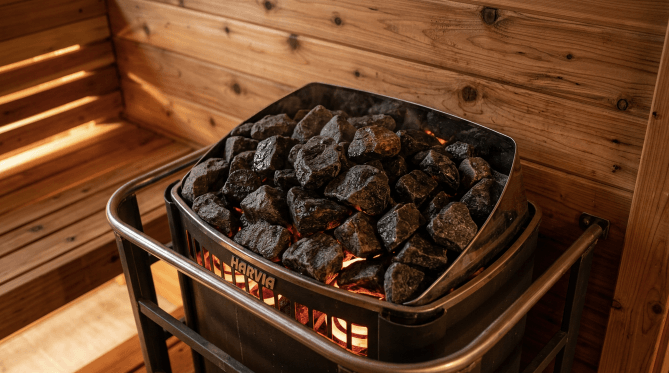
Sauna stones are not interchangeable with generic landscaping rock. Look for basalt, peridotite, or olivine river stone sold specifically for sauna use, sized to whatever the heater manufacturer specifies, typically 3 to 5 inches across for a home electric unit. The stone bed’s job is to hold heat and release a burst of dry steam when water hits it from the ladle, and stones that are too small pack too tightly and restrict airflow through the element, while stones that are too large leave gaps that reduce total heat storage. Skip stones gathered from a yard, quarry, or riverbed. Untested rock can hold trapped moisture that turns to steam inside the stone and causes it to crack or pop when it heats up, which is both a mess and a minor safety hazard.
Step 2: Install a Guard Rail Sized to Your Room
A guard rail keeps bare skin, loose towels, and robe ties away from the stones and heating element, and most heater manufacturers specify an exact mounting height and clearance distance in the install manual rather than leaving it to guesswork. This matters even in small rooms where the heater sits in a corner away from the main bench, since a guard rail also stops someone from brushing against the unit while adjusting the vent, refilling the ladle, or simply moving around a tight space. Buy the rail rated for your specific heater model, since aftermarket generic rails do not always match the clearance dimensions the heater needs to vent properly.
Step 3: Get a Bucket and Ladle Built for Heat
A wood or stainless steel bucket paired with a long-handled ladle is how you control steam, known as löyly, by pouring small amounts of water over the hot stones. A ladle with a short handle puts your hand uncomfortably close to the heat when you pour, so look for one at least 12 inches long. Plastic buckets are a false economy since cheap plastic can warp or leach a smell into the water near a hot heater; a sealed wood bucket or a stainless option holds up far better over years of regular use.
Step 4: Add a Thermometer and Hygrometer
A combined thermometer and hygrometer, mounted at bench height rather than near the ceiling where readings run hotter, gives you an honest sense of both temperature and humidity in the room. This matters because a 170 degree room at low humidity and a 150 degree room right after a big pour of water on the stones can feel almost identical, and tracking both numbers helps you dial in a session that matches how you actually want to feel rather than chasing a single temperature target that does not tell the whole story.
See also: The Role of Innovation in Business Strategy
Where the Real Spending Should Go
For a first-time buyer working with a fixed accessory budget, the stones and guard rail come first since both are tied directly to safe operation of the heater, not just comfort. The bucket, ladle, and thermometer come next, and after that, spending on backlighting, cup holders, or aromatherapy trays is purely a matter of taste and does not change how the sauna performs. When comparing heaters and the stone or guard rail options built to match them, SweatDecks’ lineup lists compatible accessories next to each heater model, which saves the trouble of cross-checking clearance specs across separate product pages.
Step 5: Plan for Stone Replacement Before You Need It
Stones degrade with use. A common guideline is to replace them roughly once a year under regular multi-session-per-week use, sooner if you notice visible cracking, crumbling at the edges, or a white mineral crust building up from hard water in the ladle. Buying a spare bag of stones at the same time as your initial set means you are not waiting on shipping when the heater starts sounding different or the steam output drops off, which is usually the first sign that it is time for fresh rock.
Accessories That Do Not Move the Needle
Backlit stone beds, Bluetooth speakers rated for sauna humidity, and scented oil diffusers are genuinely nice additions for some owners, but none of them affect heat-up time, safety, or how long the heater lasts. If your budget is tight, it is worth buying the stones, guard rail, bucket, ladle, and thermometer first and treating everything else as a later addition once the core setup is dialed in and you know how you actually use the room.
Step 6: Consider a Timer If Your Heater Does Not Have One Built In
Many entry-level electric heaters ship without an automatic shutoff timer, which means the unit will keep running until someone manually turns it off. An external timer switch installed inline with the circuit, or a heater upgrade to a model with a built-in digital timer, adds a real safety margin for households where the sauna sometimes runs unattended for a few minutes, such as when someone steps out to grab a towel or answer the door. This is a lower priority than stones or the guard rail, but it is worth budgeting for once the core safety accessories are covered, particularly in a household with kids or pets who might wander near a hot room.
Step 7: Floor and Wall Protection Near the Heater
A heat-resistant mat placed under the heater protects the subfloor from splashes when water is poured on the stones, and a metal or cement board backing panel behind the unit protects the wall from long-term radiant heat exposure even when clearance requirements are met on paper. Neither is strictly required by every heater manufacturer, but both are inexpensive relative to the cost of repairing water-damaged flooring or a scorched wall panel a few years into regular use. Installing this protection during the initial build is far simpler than retrofitting it later, since it usually means working around a heater that is already wired and mounted in place.
Frequently Asked Questions
Do I need a guard rail if my heater is not near a bench?
Most manufacturers still specify one regardless of bench placement, since a guard rail also protects loose towels, robes, and accidental brushes near the stones during a session, not only direct contact from someone seated on a bench.
What stones should I buy for a sauna heater?
Look for basalt, peridotite, or olivine river stone sold specifically for sauna use, in the size range the heater manual specifies, usually 3 to 5 inches across. Avoid stones picked up from a yard or riverbed, since trapped moisture in untested rock can cause it to crack when heated.
Is a hygrometer worth buying for a home sauna?
A combined thermometer and hygrometer is inexpensive and helps you track both temperature and humidity, which matters because the same reading in degrees can feel very different depending on how much steam is in the air.
How often should sauna stones be replaced?
A common guideline is once a year for regular use, or sooner if you notice stones cracking, crumbling, or developing a white mineral crust from hard water, which reduces how well they hold and radiate heat.
References
- Clinical Effects of Regular Dry Sauna Bathing: A Systematic Review, Evidence-Based Complementary and Alternative Medicine, 2018
- Cardiovascular and Other Health Benefits of Sauna Bathing: A Review of the Evidence, Mayo Clinic Proceedings, 2018
- Effects of heat and cold on health, with special reference to Finnish sauna bathing, American Journal of Physiology, 2018
By Ryan Whitfield